Royal Alliance
The Old AxolotlThe Royal Alliance is a transformer alliance whose influence in Japan is built not only on political allegiance but on access to machines, power, and the infrastructure that keeps them operating. Its leaders can mobilize specialized mechs and local factions, yet its history unfolds against a steady contraction of the networks that once made distant coordination possible. As communications fail and maintenance becomes harder to sustain, an alliance able to operate across Tokyo increasingly has to become a local political order.
Organization and Infrastructure
Before the Extermination, human programmers’ growing fluency in the digital world had left them increasingly detached from physical hardware. A separate clan of IT specialists preserved practical knowledge of cables, ports, and cooling systems. Bartek describes himself as the basement beneath that basement: a hardware fixer whose skills concern the physical machinery rather than software. That distinction matters to the Royal Alliance’s world, where political and digital power ultimately depend on someone being able to maintain the devices that make them possible.
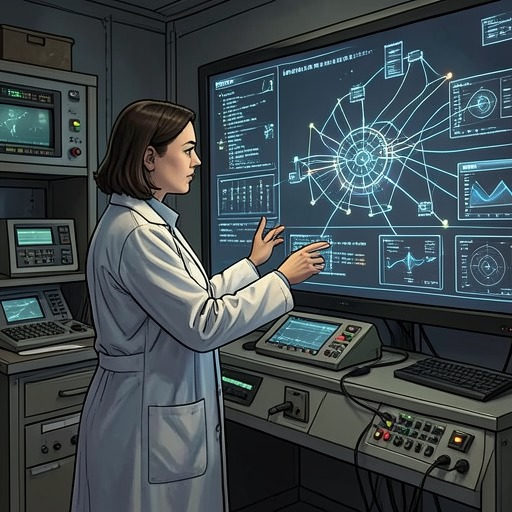
The Alliance’s activity is visible in its systems for monitoring territory and energy. During one of Bartek’s remote checks, the Royalists had updated their zones of influence across Greater Tokyo and revised alerts for power lines connected to plants in Tokyo and Hamaoka. The JPX server room at Nihonbashi Kabutocho, where most of the Royal Alliance’s transformers in Tokyo were processed, appeared green; at Chūō Akachōchin in Kyōbashi, an attendance meter recorded seven transformers. These details give the organization a concrete infrastructure: influence is mapped, power lines monitored, and transformer presence registered at specific locations.
Leadership and Military Resources
SoulEater39 is presented as the Royal Alliance’s leader in Japan and as the head of the GOATs. This position gives him first choice of machine. When he invites Bartek to a waterside warehouse belonging to the Alliance in the Keiyō Industrial Zone, SoulEater39 logs into his shogun, while Bartek operates a heavy Shift series XIV, a headless mech designed for the harsh conditions of natural disasters. The Royal Alliance has stored dozens of these Japanese machines in oil and nitrogen, preserving their fast processors and clean memories for use. Its military capacity therefore includes not just command and piloting, but also the long-term preservation of specialized hardware.
The Alliance’s strength is not confined to its own machines or personnel. At a later point, Bartek argues that if research required a new direction, Royalist GOATs and Big Castle members could be recruited to work on it. The suggestion shows how political affiliation can provide a pool of technical labor, though the Star Trooper counters that changing research fields would require recreating epigenesis in simulation and carrying out new DNA syntheses and incubations. Collective resources can offer help; they do not make a difficult scientific process simple.
Alliances, Territory, and Political Change
The Royal Alliance supports Frances Rory’s project and asks Bartek to keep the matter confidential, leaving him free to decide what to do. Its support indicates that the organization is willing to back a major undertaking beyond routine territorial administration, even while the consequences of that support remain for Bartek to weigh. The Alliance’s political influence is thus expressed through both control of local resources and decisions about which projects to assist.
Over the long term, however, the conditions of political life change. On 4529 PostApoc, the last unaffiliated transformer disappears from the world map: no independent transformer can reliably secure both hardware maintenance and a steady power supply. Later, on 7899 PostApoc, the last telecommunications satellite still carrying signals across the Atlantic fails. The undersea cables have already succumbed; the repairs once performed by human beings stopped with the Extermination, and accumulated faults and ordinary entropy eventually defeat the transoceanic lines. Without civilization-scale support, deep-ocean engineering is not a practical option. Transformers can no longer freely log into mechs anywhere in the world, and alliances and guilds harden into nations, now bound by shared language, culture, time, and place.
In Tokyo, the GOATs and Black Castle divide the city and its power plants. They unite, fracture, and unite again; the result is a political community described as genuinely Japanese. The Royal Alliance belongs to this localized landscape of power, where control of energy and territory matters more as global connectivity recedes. The account does not present its development as a simple march toward unity: factional division and renewed cooperation recur within the same regional order.
Networks Beyond the Alliance
The Royal Alliance’s political world also intersects with forms of collective agency that do not fit neatly into conventional organizations. The irigotchi were designed as cuddly toys for children in Japan, with processors capable of learning from individual owners. Each toy could develop only to roughly the level of a lizard, but after the Extermination the toys formed herds and modified their shared neuro-structure without human beings. Bartek imagines gradually building a network from a few toys and winding it around himself; the idea unsettles any assumption that intelligence or organized action belongs only to human or transformer institutions. When a Totoro toy taps random babble on a keyboard, the scene also marks the distance between emergent collective behavior and familiar, legible communication.
The alliance’s own political boundaries are similarly difficult to define in a world where person, program, and collective can overlap. Bartek is unsure whether Lady Spiro comes from a humano-transformer mixture, a long-lived vector of the Matternet, or managerial software; she herself does not know. He describes her as having grown into the Mother of Paradise, an authority that may be present throughout the network rather than located in a single recognizable office. This uncertainty provides a contrast to the Royal Alliance’s visible markers—leaders, mechs, monitored power lines, and territorial divisions—without proving that the Alliance itself has the same indistinct structure.
Significance
The Royal Alliance embodies a political order whose practical foundations are technical and material. Its reach depends on stored machines, functioning power systems, hardware expertise, and the labor of allied groups; when long-distance communications fail, local control becomes more decisive and alliance structures acquire the force of nations. The organization’s significance lies in this double movement: it can coordinate resources and support projects, but it operates in a civilization where every connection is vulnerable to breakdown and where the disappearance of maintenance can redraw the political map.